Real Estate Photography, AI Photo Editing, Real Estate Marketing
Real Estate Photo Enhancement for Agents Who Want Natural Results
Learn how natural real estate photo enhancement helps agents improve listing images without creating misleading or artificial results. See where AI helps, why human quality control matters, and what to check before publishing property photos online.
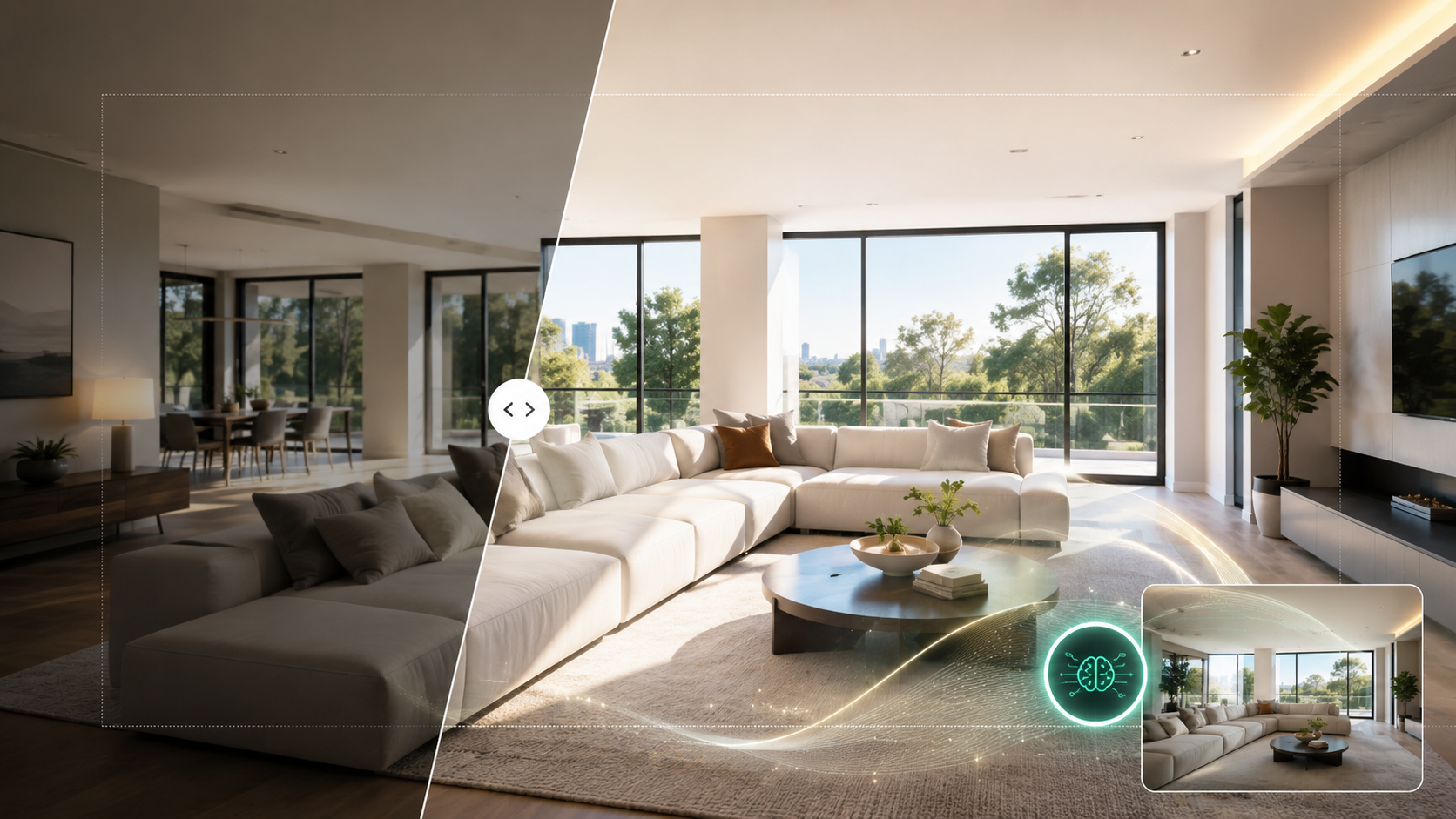
Real Estate Photo Enhancement: How to Improve Listing Photos Without Making Them Look Fake
In real estate, photos often decide whether a listing gets attention or gets ignored.
Before a buyer reads the description, checks the floor plan, or books a viewing, they usually look at the images first. If the photos feel dark, flat, poorly aligned, or simply unprofessional, even a great property can lose momentum before the conversation starts.
That is why real estate photo enhancement matters. Better listing photos can make a property feel brighter, clearer, more inviting, and more professional. But there is also a line that should not be crossed: improving a photo is not the same as misrepresenting a property.
At Immopixx, we focus on natural-looking real estate image enhancement that helps agents present properties at their best without creating an artificial or misleading result. Our approach combines smart technology with careful human review, so the final images look polished, believable, and ready for professional use.
Why Good Listing Photos Matter
The quality of a listing photo affects more than just appearance. It influences how trustworthy, valuable, and well-presented a property feels.
When listing images are too dark, badly cropped, or visually inconsistent, buyers may assume the property itself is less attractive. On the other hand, when rooms look bright, clean, and easy to understand, the entire listing feels more professional.
Well-enhanced real estate photos can help you:
- create a stronger first impression
- present spaces more clearly
- make listings feel more premium
- improve consistency across all images
- support trust before the first viewing
- make websites, exposés, and portals look more professional
For agents, developers, and property marketers, that can make a real difference.
What Real Estate Photo Enhancement Actually Includes
Real estate photo enhancement is not about turning a property into a fantasy. It is about improving image quality so the property is presented clearly and professionally.
A typical enhancement workflow may include:
- exposure correction
- color correction
- white balance adjustment
- perspective correction
- contrast optimization
- sharpening important details
- reducing visual distractions
- creating a consistent visual style across the full listing
These edits help the property look better online while still reflecting what is actually there.
If you want to see how this fits into a professional editing workflow, take a look at our services and how it works pages.
The Most Common Problems in Property Photos
A listing does not need to have “bad” photos to benefit from enhancement. In many cases, the original images are simply limited by lighting conditions, camera angle, or time pressure.
Here are some of the most common problems:
Rooms look too dark
Interior spaces are often photographed with mixed light sources or limited natural light. As a result, the room may look smaller, colder, or less welcoming than it does in real life.
Colors look off
Walls, floors, furniture, and surfaces can appear too yellow, too blue, too gray, or too dull. Even small color shifts can change the mood of a room.
Vertical lines are crooked
When a room is photographed quickly—especially with a phone—walls, windows, and door frames often appear tilted. This makes the image feel less professional.
The image feels cluttered
Temporary distractions such as cables, minor reflections, or small non-permanent objects can draw attention away from the property itself.
The full listing lacks consistency
One image may be warm, another cool, one too dark, one too bright. When that happens, the listing feels visually unpolished.
Natural photo enhancement helps solve exactly these issues.
Natural Enhancement vs. Misleading Editing
This is where many real estate professionals become cautious—and rightly so.
There is a clear difference between making a photo look better and making a property look different.
Natural enhancement improves image quality.
Misleading editing changes the perceived reality of the property.
Natural enhancement may include:
- brighter exposure
- more balanced colors
- corrected perspective
- clearer sharpness
- improved white balance
- subtle cleanup
- better consistency across the gallery
Misleading editing may include:
- hiding permanent damage
- changing structural elements
- altering views from windows
- replacing materials or finishes
- adding features that do not exist
- making the room appear larger than it is
- presenting renovations that are not real
That distinction is becoming more important in the market. In California, for example, AB 723 requires disclosure when real estate ads use materially digitally altered images, while common photo corrections such as lighting, sharpening, white balance, color correction, angle, straightening, cropping, and exposure are explicitly treated differently if they do not change the representation of the property.【turn347250view0†L74-L80】
For real estate brands, the practical takeaway is simple: optimize the photo, but do not mislead the viewer.
Where AI Helps—and Where It Does Not
AI has made photo editing faster, more scalable, and more accessible. In real estate, that is useful because listings often include many images that need similar improvements.
AI can help with:
- exposure balancing
- color improvements
- noise reduction
- sharpness optimization
- image cleanup
- batch consistency
- faster turnaround
That efficiency matters, especially for agencies and property marketers working with large volumes.
But AI also has limits.
It can overcorrect lighting, make materials look unnatural, smooth details too aggressively, or create images that feel artificial. In real estate, that is a problem because trust matters. Buyers and tenants should not feel that the listing promised one thing and the viewing delivered another.
That is why Immopixx combines AI-assisted editing with human quality control. Technology helps speed up the process, but a real person reviews the output to make sure the final image still looks natural, accurate, and suitable for real estate marketing.
You can learn more about our approach on the About page.
A Better Workflow for Real Estate Image Enhancement
A professional editing workflow should be easy to understand, reliable, and consistent. At Immopixx, the idea is not only to produce a nicer image, but to create a process that real estate professionals can trust.
A strong workflow usually looks like this:
1. Upload the images
The original property photos are submitted for review.
2. Check the technical quality
Images are reviewed for lighting, color, sharpness, perspective, and overall usability.
3. Apply AI-assisted enhancement
Core improvements are made efficiently with technology-assisted editing.
4. Review the result manually
A human reviewer checks whether the result still feels realistic, natural, and professionally presentable.
5. Deliver the final images
The finished photos are ready for websites, portals, exposés, and marketing materials.
This balance between speed and quality is one of the biggest advantages of a human-reviewed workflow.
Common Mistakes That Make Listing Photos Look Artificial
Many real estate images do not look “edited” because they were enhanced—they look edited because they were over-enhanced.
Typical mistakes include:
- overly bright windows with no visible detail
- whites that look blue or unnatural
- overly saturated colors
- too much contrast
- rooms that appear unrealistically large
- retouching that removes important visual facts
- inconsistent editing from image to image
The goal is not to make the property look perfect at all costs. The goal is to make it look clear, attractive, and believable.
What to Check Before Publishing Listing Photos
Before uploading your enhanced images to your website or a portal, it helps to run through a short checklist.
Ask yourself:
- Does the photo still represent the real property accurately?
- Does the lighting look bright but believable?
- Do colors feel natural?
- Are vertical lines straight?
- Is the image consistent with the rest of the listing?
- Were only appropriate distractions removed?
- Could any edit create false expectations?
- Is the image optimized for fast loading on the web?
This kind of quality check helps protect both your brand and the user experience.
If you are comparing options or planning your workflow, you can also view our pricing.
Why Human-Reviewed Editing Creates Better Results
There are many tools that promise instant real estate photo enhancement. Speed is useful, but speed alone is not enough.
For a professional result, the final image should be:
- natural
- clear
- visually consistent
- accurate
- trustworthy
- ready for commercial use
This is where human-reviewed editing becomes valuable. It helps prevent the common problems of fully automated enhancement and creates results that are better suited for real real estate marketing.
At Immopixx, we are not trying to create unrealistic “perfect” interiors. We help real estate professionals present properties more clearly and professionally—without crossing the line into visual misrepresentation.
Frequently Asked Questions
What is real estate photo enhancement?
Real estate photo enhancement is the process of improving listing images through edits such as brightness correction, color correction, perspective correction, sharpness improvements, and consistency adjustments.
Can enhanced listing photos still look natural?
Yes. In fact, that should be the goal. Good enhancement makes a photo look cleaner and more professional without making it look artificial.
Is AI real estate photo editing enough on its own?
AI can be very helpful, but it is not always enough on its own. Human review is important to catch unnatural results and make sure the final image is suitable for real estate use.
What should not be changed in real estate photos?
Permanent defects, structural elements, important room characteristics, views, and other material aspects of the property should not be changed in a way that misleads buyers or tenants.
Who benefits from real estate photo enhancement?
Real estate agents, developers, property managers, architects, photographers, and real estate marketing teams can all benefit from higher-quality, more consistent listing images.
Final Thoughts
Real estate photo enhancement works best when it improves the quality of a photo without changing the truth of the property.
That is exactly where natural editing makes the biggest difference. It helps listings look brighter, clearer, and more professional—while still giving buyers and tenants a realistic impression of what they can expect.
For real estate professionals, that balance matters. It protects trust, improves presentation, and supports better marketing.
If you want listing photos that look polished without looking fake, contact Immopixx or explore our real estate photo editing services.